

Russia and China’s veto is not against Syrians, but against West’s hypocrisy

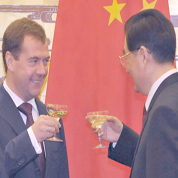
In a move reminiscent of fearless actions in the multipolar world of bygone days, Beijing and Moscow decisively acted in a marked unison to counter another largely one-sided, Western powers-led UN Security Council’s questionable resolution, aimed at gaining some geopolitical dividends and expansion of their strategic national interests in the Middle East, at the expense of the other members of the international community. This is the first time such a bold step has been taken in recent memories by Russia and China to safeguard their strategic national interests, while at the same time undermining the West’s questionable and egoistic agendas on the global arena.
Russia and China are two of the powerful five permanent Security Council members — along with the United States, United Kingdom and France — with absolute veto powers over the elitist club’s decisions that are binding on all UN member states. It was the grotesque failure of Moscow and Beijing to act in a similar manner last March that eventually gave the West the diplomatic leeway to effect a political regime change in Libya via a NATO-led military intervention that undermined the country’s deposed leader, Moammar Gadhafi, exposing him to be brutally murdered in a cold-blooded manner by his political opponents.
It seems the West had again wanted to mask their real geopolitical intentions in Damascus with its ‘traditional humanitarian necessity,’ the very same linguistic ploy used to fool Moscow and Beijing, when a similar resolution adopted in 2011, allowed the United States and European Union to brazenly exploit the diplomatic loopholes in the resolution to support the Libyan opposition. In practice, the Western states simply used the Security Council as a blind to effect a ‘political regime change’ in a country that is very hostile to them via a cold-blooded military intervention that was not formally endorsed by the UN. Moscow and Beijing, which had, for inexplicable reasons, opted for ‘diplomatic abstention,’ instead of outrightly vetoing the strategy, were humiliatingly sidelined as impotent superpowers, and consequently, had to stand idle as the bloody drama of military intervention unfolded in Libya with direct and collateral human losses on both sides.
Remembering the horrible outcomes of the Libya debacle, Moscow and Beijing, defying the unprecedented pressures from both the Western and Arab worlds, unflinchingly snuffed out the questionable resolution that was allegedly aimed at ending the ongoing power struggle in Syria between incumbent President Bashar al-Assad and the opposition discontent with the prevailing political status quo in the country. The contested resolution was, amongst others, totally condemned by Russian Ambassador to the UN Vitaly Churkin for its being based largely on the Arab League’s plan that unequivocally calls for Assad to step down without placing any demand or assigning responsibility for the ongoing crisis on the opposition.
This line was highlighted further by Russian Foreign Minister Sergei Lavrov, who in his defense of the Kremlin’s veto, called the Western powers’ reactions “indecent cries bordering on hysteria aimed at distorting the real state of affairs in Syria.” And, noting that the questionable resolution should not have come to a vote ahead of his visit to Damascus, he condemned the decision to go ahead with vote as disrespect to Moscow. “What made the resolution, backed by the Arab League and Western powers, one-sided, was its demand on the Syrian president to unconditionally cede power to the opposition and end anti-insurgency actions, without also imposing corresponding obligations on the armed groups battling the official regime,” the Russian top diplomat added.
From its side, China also issued a comprehensive condemnation of the Western powers’ handling of its veto decision, saying the resolution and its authors were seeking to realize a forced regime change in Syria that did not adequately reflect the real state of affairs in the country. By exerting pressure only on the official Syrian government and explicitly trying to coerce its leader to step down, the resolution, if passed, would have sent the wrong message to the armed groups and opponents of the regime that they have the full support of all the members of the international community, which they currently did not, a scenario that would have undoubtedly made the Syrian situation even more complicated, a representative of the Chinese government said.
Specifically, China noted that the Western countries’ previous and ongoing campaigns in Libya, Afghanistan and Iraq are gaping evidences of the errors of forced regime changes and their blatant failures to effect the long-desired restoration of peace and stability in such countries. “The situation in Syria continues to deteriorate and numbers of casualties have continued to increase. Vetoing this resolution does not mean we are giving free rein to letting this state of affairs continue,” the Chinese government said. “Beijing, unlike its western critics, was acting responsibly for the sake of the Syrian people. Currently the situation in the country is extremely complex. Simplistically supporting one side and suppressing the other might seem a helpful way of turning things around, but in fact it would be sowing fresh seeds of disaster.”
Citing the Libyan case as a basis for its present decision, Beijing further argued that the West, in its vigorous enforcement of the “No-fly Zone Resolution on Libya” had gone beyond the official scope of the resolution’s sphere of direct influence, and consequently, violated both the letter and spirit of the resolution’s mission. “Libya offers a negative case study, as NATO grossly abused the resolution on establishing a no-fly zone over Libya and directly provided firepower assistance to one side of the conflict.”
Beijing went on further to cite the negative outcomes of the West’s previous interventions in Iraq and Afghanistan as its premises for vetoing the Syria resolution. “The calamities in Iraq and Afghanistan should be ample to wipe clear the world's eyes. Forceful prevention of a humanitarian disaster sounds with a sense of justice and responsibility. But are not the unstoppable attacks and explosions over a decade after such forceful regime changes a humanitarian disaster in those countries?”
Without dramatizing the impacts of the veto on the Syrian crisis, and name callings as being done by the United States, Great Britain and France, the Moscow and Beijing’s stance could be likened to an action of dissenting members of a court’s jury, who are unsatisfied with the quality of evidence presented to them by a prosecutor, who instead of presenting a case based on hard facts and figures, wrongly assumes that he can coerce a guilty verdict out of the jury via shameless manipulation of judicial procedures, hysteria and personal attacks on the accused and his defender. In the Syrian case, this simply means that the resolution authors have woefully failed to do their homework, and that if they really need an effective resolution on Syria backed by all relevant superpowers, they will have to present a much fairer draft that will attribute to all the ‘warring sides’ both blames and responsibilities equally or proportionally to their stakes in the conflict.
Russia and China have reiterated over and over again that their vetoes were neither in support for, nor against Assad, but an attempt to prevent the Security Council from repeating its fatal error in Libya in Syria by siding with one of the two sides involved in a national conflict, and wrongly promoting a forced regime change, thus undermining its neutrality status in responding to intergovernmental crises across the globe. This argument, taken on its face value, seems cogent enough to justify the veto decision, even if there were other more sinister hidden geopolitical motives behind it.
And, if this logical and well-articulated response is a reflection of Beijing and Moscow’s view on the new architecture of their much-clamored-for ‘multipolar world’ and a model of their behaviors in the looming post-crisis era, then the West, and notably, the United States, after almost two decades of executing unilateral diplomatic actions with questionable outcomes across the globe, will now have to make real adjustments to its international diplomacy doctrine.
This is to be expected as the voices of China with a more viable economy in the post-crisis era, and resurgent Russia under Vladimir Putin on his way back to the Kremlin as the nation’s president are certain to be much more vocal and demanding in protecting their strategic national interests and issues of global and regional importance. Such is this new reality of today that the West — seriously humbled and decapitated by the global financial crisis — will now not only have to live with it, but will also have to factor it into its new behavioral and policy strategies on the international arena, if it still needs to play vital and meaningful roles on the global geopolitical stage.








 Web design,