

Russia will gain from the abrogation of its gender political inequality

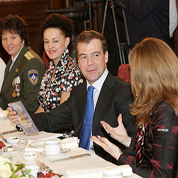
At a Kremlin reception organized in honor of outstanding Russian women that have excelled in all spheres of human endeavors on the eve of the March 8 International Women’s Day, President Medvedev lamented the unacceptably low level of number of women in top government positions and promised to remedy what could be politically correctly labeled as ‘growing deplorable female gender inequalities’ in the country. Indeed, till March 12, when the president started fulfilling his promises by appointing Elena Skrynnik the new agriculture minister, the number of women in the upper echelon of the Russian government could be counted on the fingers on one hand. These include ‘veteran’ Cabinet members — Health Minister Tatyana Golikova and Economic Minister Elvira Nabiullina — and St. Petersburg Gov. Valentina Matviyenko, the only woman in the nation’s overtly male-dominated gubernatorial corpus, long seen as ‘a men-only-political club.’
The exact reasons that suddenly prompted the president to highlight this centuries-old practice of female alienation from public governance remained unclear, but it might 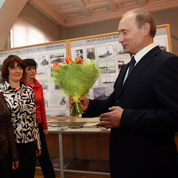 be that he was really carried away at the reception by his invited guests’ unprecedented achievements in rare and ‘non-typical-feminine’ professions. Whatever the reasons, the Kremlin now needs to accelerate its snow-like speed of abolishing gender discriminations in political appointments as such policy currently equates Russia with countries with the world’s worst gender practices. Indeed, the current number of women in Russia’s top political hierarchy compares favorably only with those of former Soviet Union republics — with the notable exceptions of Ukraine, Moldavia and the Baltic states, where women have excelled in public politics — and, also with some developing countries, specifically, the Moslem world, where women are traditionally relegated to the sidelines of society’s political life by archaic discriminatory practices and odious religious bans on gender basis that ought not to exist in the 21st century.
On the other hand, the Russian gender policy is ‘light years’ from similar practices in the more developed western states, such as France, where the number of men and women are almost equal in the Cabinet, and other European states, where the male-to-female ratios oscillate in proportions that reflect each genders’ roles in societies, and finally, the United States, where President Obama has appointed a record number of women, including Hilary Clinton, to key government posts. It must be noted that the appointments of women to high positions in these countries are the norms, rather than exceptions, and, consequently, are not used as a means of pursing a special policy on gender equality, but on tapping all citizens, their intellectual resources and human potentials for the benefit of all. This is why the earlier Russia, which is richly endowed by nature with some of the world’s most talented women, joins the latter group, the better for the country and its future.









 Web design,