

Radicalization of protest sentiments in society and labor conflicts in companies


One of the most glaring examples and recent manifestations of the social repercussions of the economic decline was the massive protests on April 12 across the country by people who do not agree to some of the anticrisis measures that have led to increases in communal utility tariffs and hikes in import duties on cars. Specifically, the latter forced members of the Federation of Russian Car Owners (FRCO) to organize massive anti-government rallies across major cities in the country. “There are many people that are dissatisfied with the situations in the country, who cannot take part in legal actions to express their discontent, because of a lot pressure from the government to discourage such demonstrations,” Sergei Kanayev, head of the FRCO’s Moscow Branch, said at the April 12 rally in central Moscow.
Striking moods breeding across society and economy
Despite the existing pressure from the government to dissuade mass protests, it seems more and more people are now ready to go to the streets and/or participate in labor strikes to express their concerns over the situation in the economy and country, a growing negative trend seen from several protest actions and labor strikes organized in the country since the beginning of the year. 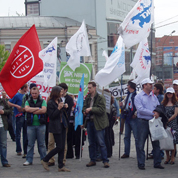
For instance, in late March 2009, a group of miners in the Rostov Region-based Chikha Mining Co., a subsidiary of Rusincor, a St. Petersburg-based corporation, began a strike in an attempt to force the management to pay a long-overdue multimillion wage arrear. The strikers pledged to remain in the mine shafts — miners’ favorite traditional striking regime — till all the wages in excess of R15mln, are fully paid. The Rostov miners strike brings to mind a similar strike exactly a year ago, in March 2008, at the Krasnaya Shapochka Mine, a Northern Urals subsidiary of RusAl, which is controlled by Oleg Deripaska, the aluminium magnate multibillionaire, when over 100 workers refused to leave the mine, demanding increases in salaries and improvement in working conditions.
Indeed, the situation in the Russian coal industry is particularly pathetic because most of the adopted plans to reform the sector have either remained on papers, while those that were executed had failed to yield the expected results. It is, therefore, not surprising that CEOs of leading coal companies are also dissatisfied with the overall situations in their sector, and consequently, are preparing a very seriously worded petition to President Dmitry Medvedev. Specifically, the petition contains clear warnings on the worsening conditions in the industry and the possibility of extremely negative consequences in delaying measures needed for stabilizing the industry, and the whole economy in general. “If the necessary measures are not taken to stabilize the industry, millions of miners will lose their jobs, and this might warrant declaring a state of emergency in the over 50 densely populated settlements that serve as residences for the miners,” the CEOs stated.
According to experts, the dismal situation in the Russian coal industry typifies the general negative trends in all sectors of the domestic economy, which has recently come under the ‘heavy wheels’ of the global economic recession, a phenomenon that has further exacerbated the already dire labor conditions in majority of Russian companies. The gaping inability to successfully run businesses, especially in crisis situations that have exacerbated a myriad of problems suppressed over the years and left solved even during the rather comparatively favorable pre-crisis period, is now evident in most companies, as the negative consequences of the missed opportunities for restructuring, improvement and innovation, are now visible today throughout the whole economy.
According to the data released by the Institute of Globalization and Social Movements (IGSO), which studied the issues of rising exacerbation of labor relations and rising strike moods in Russian companies, including structures affiliated with Deripaska, new strikes are expected in the coming months in most Russian companies, especially those belonging to the aluminium magnate. “Escalation of labor conflicts can be expected, first of all, at factories that are affiliated with RusAl and RusPromAvto, while the reasons for the worsening relationships stem from poor working conditions, unwarranted reprisals against labor union activists and the management’s policy of not dialoging with labor unions,” IGSO noted, citing its analysis of the situations in the two companies. “Health hazards, openly harmful and dangerous working conditions, low wages, illegal practice of constant overtime hours and non-recognition of labor union organizations are some of the commonest problems in most Russian companies, all of which are bad conditions for creating ‘a model image’ of successful corporations,” the IGSO said.
 Anna-Stefaniya Chepik, head of Corporate/HR Practice at law firm Pepeliaev, Goltsblat & Partners: “In my opinion, company employees may resort to striking only when all other available legal avenues — negotiations, mediation commission, etc. — have been exhausted, but not before.”
Reasons for worsening labor relations
According to IGSO’s data, most Russian companies and foreign corporations operating in Russia operate in difficult labor conditions, posing real life-threatening health haphazard to the employees, while the managements in some companies intentionally provoke their employees’ anger by executing policies of repressions and illegal firings. “In summary, the main reason for the worsening of labor relations in companies is the managements’ total disregard for the overall welfare of their employees, as workers’ wages in companies under the threats of imminent labor strikes are unacceptably low and without tangible prospects for significant increments in the foreseeable future.
By all indications, it seems the prevailing artificial tranquility in the frozen confrontations between labor unions and employers, which was caused by the stringent requirements in the current legislation on industrial strikes, is now coming to an end. This is evident in the increasingly visible signs of new types of independent, more active labor associations all over the country. These new unions are not accountable to the officially recognized labor organization, the Federation of Independent Trade Unions of Russia (FNPR), and therefore, are more radical and persistent in their demands both to the state and private employers, whose companies are facing huge losses due to increasingly incidents of unsanctioned work stoppages.
Particularly, the new labor activists, as parts of their priority wish-lists, are not only inflexibly demanding the full liberalization of the existing legislation that makes industrial actions almost impossible, increases in salaries and restraining the galloping inflation rate that is wiping out the citizens’ modest incomes, but also have declared their readiness to take practical steps aimed at achieving the stated objectives, in spite of the existing legislation, threats of court actions by their employers and/or possibility of losing their jobs. According to IGSO, Russia is currently witnessing sharp escalations in labor relations between the new trade unions and their employers.
These increasing strike sentiments are now evident in almost all sectors of the Russian economy. For example, it took the Omsk’s Kirov district court injunction on Jan. 29 to oblige the city airport employees to call of their strike scheduled for Jan. 30, in part because it is the only such facility in the city. Similarly, there was a taxi drivers strike in Moscow in mid-February against what the strikers had called the ‘draconian labor policies’ of the management, which uses its staff to solve its financial problems. Expectedly, the management’s reaction was swift and ruthless, as all the strike participants were sacked instantly. 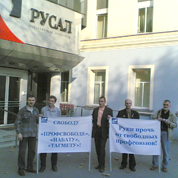
In a related development, the employees of Moi Gorod, a Taganrog-based retail supermarkets network, declared a strike at the end of February aimed at pressurizing the management into paying overdue salaries. Regnum news agency, citing the employees’ complaints, reported that the management offered the workers at the end of 2008 to sign that they had received their wages, while in reality they did not, threatening to pay those who declined to do so only the official salaries, which are usually less than the real ones, when the actual payments will be effected. “However, no one has received anything since that time.”
Similarly, Russian teachers are on the verge of striking, according to the Zavuch.info site, citing their plans to hold all-Russian teachers and parents meetings throughout the country in April, where they plan to express their displeasure over the current remuneration system for government employees. The idea of calling such a national meeting has been supported by over 80% of teachers polled by the site. “The nationwide meeting will be last attempt to get our demands across to the Education Ministry bosses,” the meeting organizers said. Another case took place on April 3, when about 120 employees of SPZ, a unique ship building and repairing factory in the Roslyakovo settlement in the Murmansk Region, went on strike to get their salaries. “Strike is the only opportunity to draw the authorities’ attention to our plight, as we have not received our due salaries in the past five months,” the strikers said.
Commenting on the issues of rising labor tensions between employers and their employees in Russian companies, Anna-Stefaniya Chepik, head of Corporate/HR Practice at the Moscow law firm Pepeliaev, Goltsblat & Partners, called the ongoing activation of trade unions’ activities a ‘normal phenomenon’ that is just getting started. “The current intensification of labor unions’ activities in Russia is normal, which is expected to continue to grow further,” she said, adding that there are enough premises for such forecasts. “This is because, compared with the trades unions’ activities in other European countries, and particularly, the role they play in the regulation of their labor markets, I would like to say that their Russian counterparts are only just getting started.” (see the Expert’s Rubric for Chepik’s full view on this issue).
Strikes also becoming frequent in foreign companies
Strikes are not only occurring in Russian companies, known for their traditional disregard for employees’ rights in terms of salaries and working conditions, but also in foreign corporations, where one might have expected relatively better employer-employee labor relationships. However, according to human resource experts and foreign corporation labor leaders, foreign companies have quickly adopted the ‘worst practices’ in Russian enterprises, with some establishing even worse conditions in their Russian subsidiaries than those at similar enterprises in other countries. “By adopting practices similar to those in Russian companies, multinational companies operating in Russia are similarly encountering rising cases of industrial strikes,” IGSO Director Boris Kagarlitsky said.
Here, a perfect example that readily comes to mind is the incident at Ford Motor Co.’s Russian plant in the Leningrad Region, where a drawn-out strike practically brought the activities of the autogiant to a standstill. According to Russia’s Ford Labor Union, the workers’ demands included a new collective work agreement, which will contain guarantees on wages, occupational health safety and social benefits that are comparable to those in companies of the parent corporation in other countries. “The labor union decided to carry out the strike, when the management failed to accept our demands,” the Labor Union leader, Alexei Etmanov, said. “This strike showed that the majority of workers are decent people ready to fight for their rights to improvement in working conditions and salary increases.” 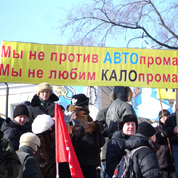
Apart from Ford, the striking ‘fever’ has also engulfed the U.S. General Motors Corp.’s Russian subsidiary located in the St. Petersburg suburb of Shushara, following the formation of a new labor union at the plant in December 2008, to fight against what the new labor activists had called ‘the management’s unbecoming behavior, fear of losing jobs in connection with the ongoing crisis, and finally to secure the guaranteed increases in workers’ salaries as stipulated in their labor contracts.’ All these negative factors have created conditions for unrests and strike sentiments at the plant, the Labor Union chairman, Yevgeny Ivanov, said. “We have been promised that the factory will move into a full week-working regime in six months’ time, and that is when we shall be fully paid. But we need to live now, feed and clothe our children today and repay our loans now, not in six months’ time,” he added. “If we cannot achieve the transition to a full week regime, we are ready to on picket, and we have enough resources to do so.”
Commenting on the strained labor situations in Russian and foreign companies, using the Ford incident as an example, Yevgeny Gontmakher, the director of the Social Policies Center at the Institute of Economics of the Russian Academy of Sciences, said such actions demonstrated how the new working class is taking shape, and how browbeaten workers are turning into people with dignity. “These workers have understood that they are receiving far less for the work done, and the feeling of solidarity in the struggle for their rights is nothing less than a sign of a healthy economy,” he added. “In such situations, the plant’s management ought to seek a compromise.”
New labor unions seeking alliances with leftwing parties
Industrial strikes were a relative rarity in Russia between 2000-08 since under the existing legislation the labor union leadership must obtain the consent of more than 50% of a company’s workforce and meet other stringent requirements to carry out a strike. Therefore, according to experts, it has become practically impossible to carry out legally sanctioned strikes in the country, since it is unrealistic in practice meet all the conditions, such as the consent of 50% of the employees, especially in large corporations employing hundreds of thousands of workers, scattered throughout the country, and sometimes even abroad. “Thus, the LC adopted in 2001 practically outlawed strikes. However, by 2008, the country saw increased strike actions and formation of new independent labor unions, regardless of the employers’ positions on the issue,” Kagralitsky said. 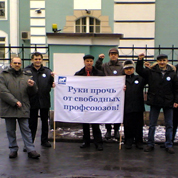
There is also active cooperation between the trade unions, not sharing FNPR’s policies on protecting workers’ interests, and the leftwing political organizations, which are independent of the country’s major political parties. This year, as it was in 2008, the independent labor unions’ May 1 demonstrations were not held with the official political parties and labor unions, but with leftwing political organizations. In particular, the demonstrators’ main demands were the liberalization of strike procedures and increases in wages.
Local labor activists seeking alliance with foreign colleagues
Besides, the new labor unions themselves are becoming more active in protecting their interests and becoming better organized in defending their rights by acquiring the needed knowledge from their more experienced foreign colleagues.
For example, some leaders of the new labor union movements in Russia are actively taking parts in international labor union conferences. The exposure to their more advanced foreign colleagues with more extensive experiences in fighting for labor rights in their respective countries and the exchange of knowledge, practical advice and recommendations via the Transnational Information Exchange programs, have started to bear fruits in Russia in terms of better advocacy for labor interests.






 Web design,