

A fully disappointed Kremlin outlines tough measures to nullify future U.S. antimissile shield in Europe

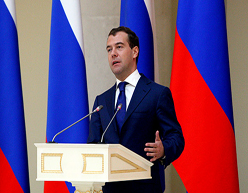
MOSCOW, Russia — The outgoing Russian president, Dmitry Medvedev, has announced a comprehensive arsenal of tough measures that the Kremlin plans to effect if the United States and its NATO allies go ahead with the implementation of their highly controversial missile defense shield project in Eastern Europe, dangerously closer to the Russian borders, that is allegedly aimed at counteracting probable nuclear attacks from rogue states, notably, Iran.
Addressing the nation on the issue, a fact that underscores the gravity of subject matter, the president declared that Moscow would be forced to take both symmetric and asymmetric countermeasures to ensure that its concerns and vital defense interests are properly and fully taken into consideration should the West, led by the United States, continue to ignore Russia’s legitimate apprehensions as it pushes ahead with the deployment of its strategic armaments in close proximity to the Russian borders, and thus tilt the fragile strategic equilibrium of nuclear forces in Washington's favor.
Briefly put, the Kremlin’s array of unprecedentedly tough retaliatory measures will range from targeting the U.S. missile defense sites in Europe, deploying new long-range nuclear missiles capable of outsmarting the U.S. and its NATO allies’ missile defenses, unilaterally revoking the hard-gained Russian-U.S. START nuclear arms reduction treaty penned in Prague, abandoning the mutually binding strategic arms control and disarmament process, amongst others.
“If these measures prove inadequate, Russia will swiftly deploy its latest, state-of-the-art strike systems, including the dreaded Iskander missile complexes in strategic locations across the country, including the Kaliningrad region, sandwiched between Poland and the Baltic States, where they can hit and destroy such missile defense installations in Europe,” the president said. “In the event of unfavorable developments, Russia reserves the right to stop the ongoing cooperation with the United States in the fields of disarmament and strategic weapons control,” Medvedev said. “Besides, given the inseparable interconnection between the strategic offensive and defensive weapons, Moscow also reserves the right to unilaterally withdraw from the START agreement, a provision included in the treaty.”
The Kremlin’s tough talk and the U.S. State Department’s defiant response that the Russian stance will not influence Washington’s decision on this policy have effectively put an end to the “newly reset rapprochement” in the two nations' bilateral ties after a period of highly dangerous roller-coaster relations under the erratic Bush administration. However, the Russian president specifically noted that he was not ‘burning the bridge’ yet, as he remains fully open to “a constructive dialog with the U.S. and NATO on the missile defense issues and negotiations that will really factor in his country’s legitimate concerns and national security interests.”
By Christopher Kenneth





 Web design,