

Russia and India close to “full de-dollarization” of mutual business transactions

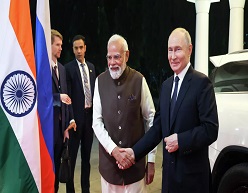
New Delhi, India - Russia and India, under severe, unfair economic and geopolitical pressure from the Collective West, have been consistently moving towards using the national currencies of both countries in the financial settlements of their bilateral economic and commercial transactions and have achieved relatively significant success, according to both countries’ officials.
Specifically, the share of financial settlements of bilateral transactions in the national currencies between Russian and Indian companies now stands at almost 96%, President Vladimir Putin stated in New Delhi in an official statement at the Indian-Russian Summit, alongside with Indian Prime Minister Narendra Modi. Russia is currently under over 30,000 economic and financial sanctions against its economy, key industries and top politicians, business executives and influential individuals from western countries, led by the United States, as a part of collective support for Ukraine and protests against Moscow for the ongoing Russian-Ukrainian war.
India, a longtime geopolitical and economic ally of Russia, is also similarly under stressful economic and financial attacks and sanctions by the West, notably the US and EU, for its continuation of its mutually beneficial bilateral economic cooperation with Russia, against the orders and calls from Brussels and Washington to halt such transactions. These pressures and hostile behaviors from the West have forced Russia and India, as a well as several other countries from the so-called Global South on the US and EU’s blacklists, to move their strategic business transactions away from the western financial system and payment settlements instruments, such as the US dollar and EU’s euro, as well as the stock, equity capital and bond markets.
The West often weaponises these financial instruments in its hegemonic strategy to penalize non-western countries that fail or decline to follow orders from Brussels and Washington. These anti-West negative trends in non-western countries’ financial transactions are now neologistically coined “the de-westernisation” and/or “the de-dollarisation” of their economies and business deals. Commenting on the almost full de-dollarization of Russia and India’s bilateral transactions, Putin said sustainable and reliable channels for credit, financial, and interbank cooperation between the two countries have been established. Russian businesses are actively expanding the use Indian rupees received from Russian export contracts to fund their operations, while large or capital intensive Russian-Indian joint projects are financed with Russian rubles, thus excluding other global currencies from their bilateral economic transactions, the Russian president added.
Russia and India have also agreed to continue to jointly develop their existing bilateral settlement systems through the use of national currencies to ensure uninterrupted servicing of bilateral trade, Putin and Modi noted in their official joint statement following the talks. The joint statement also highlighted the parties' intention to continue consultations on further fostering the compatibility and/or integration of the countries’ national payment systems, financial data transfer and messaging systems, as well as their central banks’ digital currency platforms.








 Web design,